Your First Direct Report Might Not Be Human
Nov 01, 2026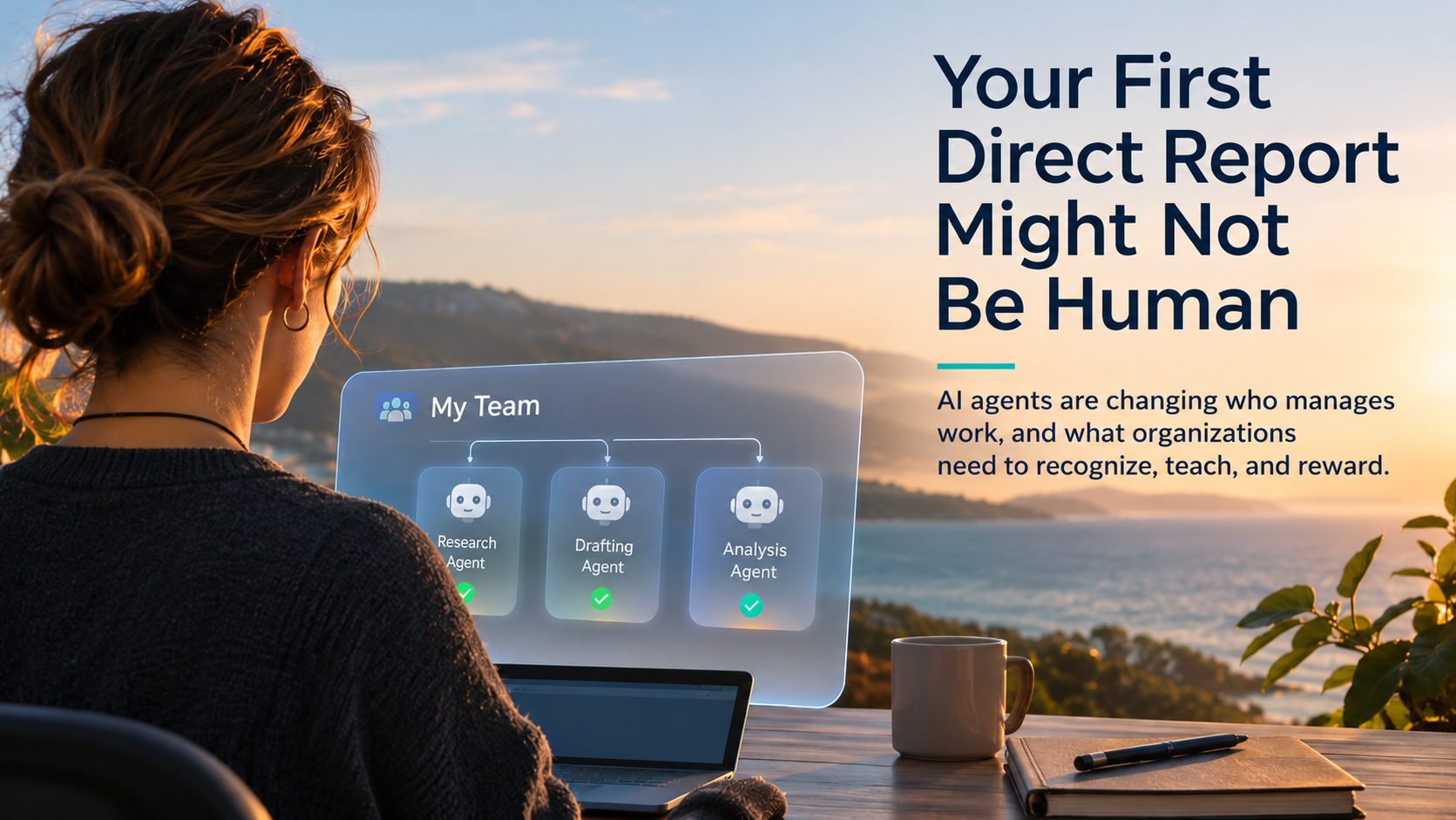
By Mark Sylvester
On October 21, nearly 200 people filled Cabrillo Pavilion in Santa Barbara for “The Future of Work: Humans + AI Agents,” a panel hosted by Ventech, a nonprofit that connects business and technology people on the Central Coast.
Mike Wald, one of our founders and a Ventech board member, moderated. The panelists were Diana Pereira, founder and CEO of Balance Financial Management; Josh Narva, a partner at the executive search firm Riviera Partners; and Jimi Smoot, CEO of Assist Technologies. Early in the evening, Mike asked who uses a chatbot at least once a week, and about 90 percent of the attendees raised their hands.
Near the end, Mike asked the panelists whether knowing how to manage AI agents will become as important as knowing how to manage people. Diana Pereira said the two are equally important, because agents that underperform need retraining the same way people need performance metrics. Josh Narva said learning to manage agents will matter, “whatever that means,” and spent the rest of his answer on managing people. Nobody on the panel described what managing an agent involves day to day, and we read that as a sign of how new the job is.
Our own agents
All three of our founders manage agents every day. I work with Reed, my personal agent on Instinct, a service people reach by text message or phone call. Mike Wald builds his agents on Lindy, a platform for creating AI agents that work across business apps. Jim Sterne works with Viktor, an AI coworker that operates inside Slack and Microsoft Teams. None of the founders' agents appears on an org chart or gets a performance review, but we assign them work, evaluate what they produce, decide what ships and what goes back for revision, and answer for the outcome. When an agent gets something wrong, the mistake is ours, which is what management means.
The Ventech panel left open what managing an agent involves day to day, and our answer is three capabilities: intentionality, taste, and judgment. Intentionality means you know what you want to accomplish and why before you assign anything, so you can set the objective, the constraints, and the standard for good work. Taste is how you recognize whether a result is right or only technically complete, and Jimi Smoot named taste at Ventech as one of the things that make a person hard to replace. Judgment is what you bring when an agent's confidence exceeds its accuracy, which happens more often than most people expect, because an agent doesn't know what it doesn't know.
The cost of an unnamed job
When an organization doesn't recognize agent management, it leaves accountability gaps. An employee who directs agents that talk to customers, change business systems, or influence financial decisions is responsible for those outcomes, and an organization that hasn't named that responsibility hasn't governed it either. Nobody has set permissions, approval thresholds, performance expectations, or training, so the agents keep working while accountability for their output floats. The failure belongs to the system, even when it looks like a people problem.
The work the org chart misses
The workforce is ahead of the org chart, and most executives are behind both. Employees experiment, find that agents can handle more than they expected, and widen the work they hand off so gradually that most executives miss it. An employee starts by asking an agent to summarize a document, and six months later runs a three-agent workflow that handles customer research, drafts communications, and reviews quality before a person sees anything. The org chart still shows one individual contributor, while the work looks like a small team's.
Middle managers are the most exposed. Someone on a manager's team, still an individual contributor on paper, may now direct agents that produce more in a week than the manager oversees across the whole group. The contributor has more operational reach, more decisions to make, and more riding on each choice than their title suggests, while the manager is still working from the old picture of the team. The conversation between the manager and the contributor is uncomfortable when it finally happens, and organizations are having it now without a framework to guide it.
Microsoft's 2025 Work Trend Index, a survey of 31,000 workers in 31 countries, found that 36 percent of leaders expect their teams to be managing AI agents within five years. From what we see working with organizations on the Central Coast, five years is too slow an estimate.
One thing to try
Ask your people to describe the last task they gave an agent, and then ask four questions:
What outcome did you specify?
What could the agent do without checking in?
How did you judge what the agent produced?
What would have happened if the result was wrong?
Sources
Jorge Mercado, “Ventech panel discusses AI and effects on the workplace”, Pacific Coast Business Times, October 28, 2026.
Panel quotes are from our recording of Ventech's “The Future of Work: Humans + AI Agents,” Cabrillo Pavilion, Santa Barbara, October 21, 2026.
Instinct, a personal AI agent.
Lindy, a platform for building AI agents.
Viktor, an AI coworker for Slack and Microsoft Teams.
Microsoft, “2025: The Year the Frontier Firm Is Born”, Work Trend Index Annual Report, April 2025.